Introduction: The Race Against Trending Topics🔗
For content creators, timing is everything. Creating high-quality content around a trending topic can exponentially increase visibility, engagement, and growth—but only if you catch the trend at the right moment. Too early, and audiences aren't searching for it yet; too late, and your voice gets lost in the noise.
According to research by Content Marketing Institute, content that aligns with emerging trends receives up to 218% more engagement than evergreen content. Yet most creators consistently find themselves 48-72 hours behind the trend curve, producing content when topics have already peaked.
This comprehensive guide will show you how to get ahead of trends instead of chasing them, using both proven methodologies and cutting-edge tools like Trendly AI.
Why Most Creators Are Always Late to Trends🔗
</figure>
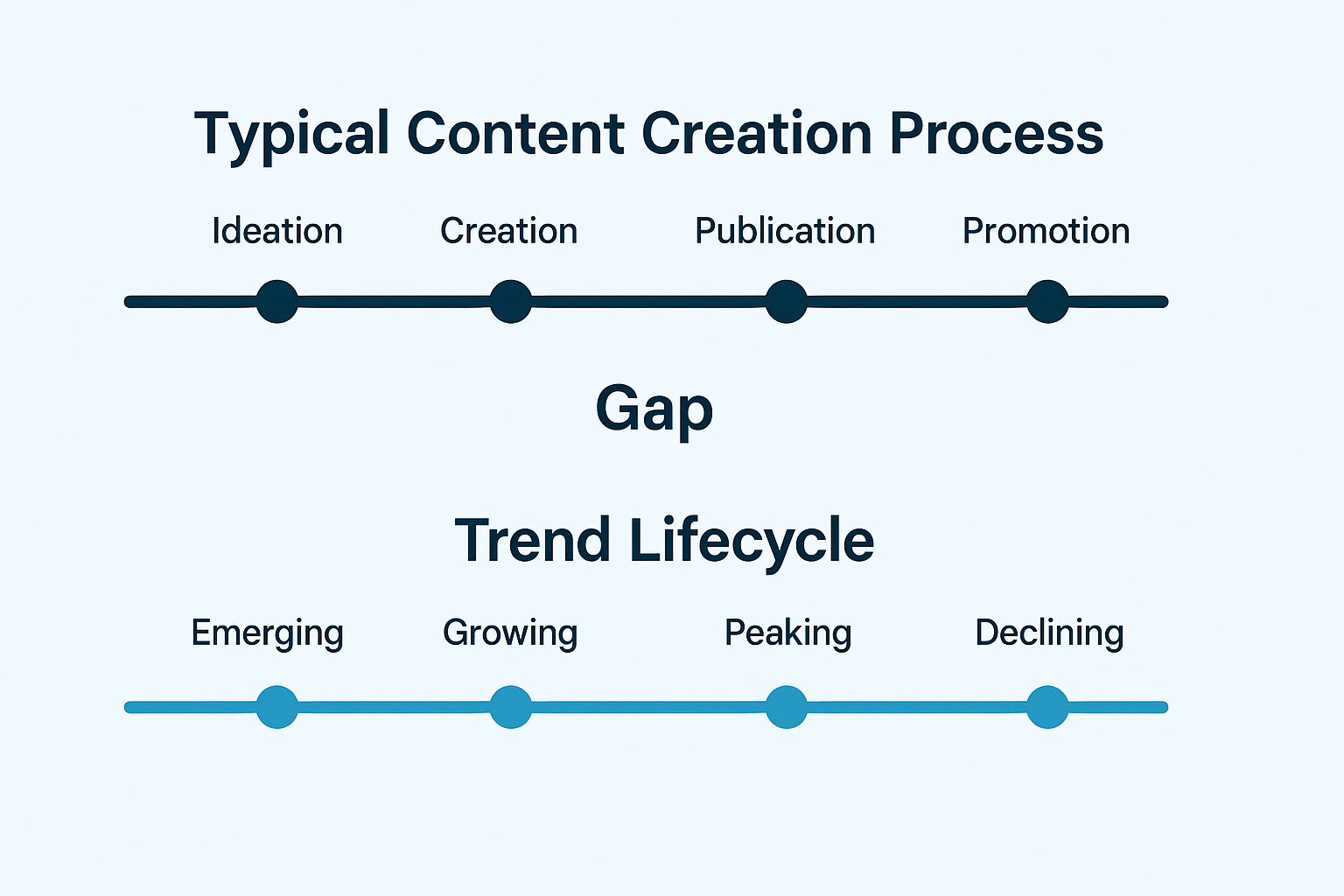
The traditional content creation workflow is fundamentally misaligned with how trends develop:
-
Discovery lag: Most creators discover trends through mainstream platforms when they're already peaking
-
Research time: Gathering information and developing informed perspectives takes hours
-
Production delay: Creating, editing, and optimizing content requires significant time
-
Publishing scheduling: Platform algorithms may not immediately distribute your content
By the time your content goes live, the conversation has often moved on. According to a study by Parsely, the average trend peaks for only 32 hours before declining in search interest and engagement potential.
Want to avoid this common pitfall? Learn how Trendly AI's trend prediction can give you a time advantage.
Early Trend Indicators: What to Monitor🔗
Successful trend prediction requires identifying signals before they become obvious. Here are the key indicators that professional trend forecasters monitor:
1. Velocity Metrics🔗
-
Acceleration rate: How quickly mentions are increasing (not just total volume)
-
Comment-to-view ratios: Topics generating disproportionate discussion
-
Cross-platform jump patterns: Topics moving from niche platforms to broader ones
2. Influencer Behavior🔗
-
Micro-influencer cluster activity: When multiple smaller accounts in one niche discuss similar topics
-
Early adopter engagement: Reaction patterns from recognized trend-setters
-
Expert questioning: When industry experts start asking questions about emerging concepts

</figure>
3. Contextual Relevance🔗
-
Adjacent trend connections: Topics related to already-trending subjects
-
Seasonal pattern recognition: Historical timing matched with current early indicators
-
Cultural moment alignment: Topics that connect to upcoming events or cultural shifts
Monitoring these indicators manually can be exhausting. See how Trendly AI automates trend detection across multiple sources.
Building a Trend Prediction System🔗
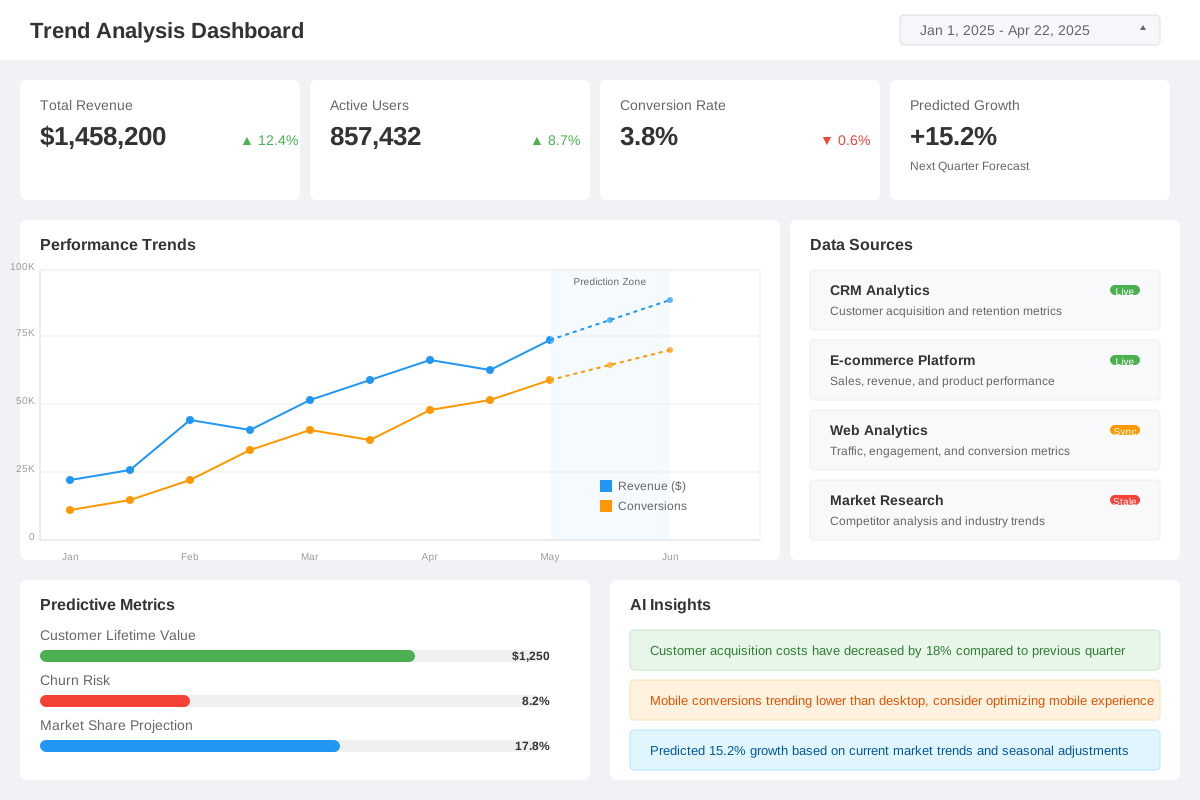
Creating an effective trend prediction system requires combining multiple data sources with intelligent analysis:
Data Collection Layer🔗
The foundation of trend prediction is comprehensive data collection across:
-
Social listening platforms: Monitoring conversations across social networks
-
Search trend analysis: Identifying early query pattern changes
-
Community forums: Tracking discussions in Reddit, Discord, and niche communities
-
News and media monitoring: Following early coverage patterns
Analysis Framework🔗
Raw data must be processed through:
-
Baseline comparison models: Contrasting current patterns against historical benchmarks
-
Context-aware filtering: Eliminating false signals and random spikes
-
Cross-reference verification: Confirming signals across multiple sources
-
Velocity calculation: Measuring acceleration rates, not just volume
</figure>
Implementation Strategy🔗
Once potential trends are identified, successful creators:
-
Prioritize based on relevance: Focus on trends aligned with your audience interests
-
Prepare modular content components: Develop templates that can be quickly adapted
-
Create content variations: Develop multiple formats simultaneously (short-form, long-form, visual)
-
Establish rapid publishing workflows: Remove approval bottlenecks and technical hurdles
For a complete implementation system, explore how Trendly AI integrates trend prediction with content creation.
Leveraging AI for Trend Prediction🔗
Modern AI tools have transformed trend prediction from art to science. Here's how advanced creators use AI:
Pattern Recognition🔗
AI excels at identifying subtle patterns across massive datasets that humans would miss:
-
Semantic clustering: Grouping related conversations even when terminology varies
-
Anomaly detection: Spotting unusual activity patterns that indicate emerging trends
-
Predictive modeling: Projecting how early signals might develop based on historical patterns
Content Acceleration🔗
Once trends are identified, AI can dramatically compress production timelines:
-
Automated research: Gathering and summarizing relevant information
-
Content generation: Creating initial drafts based on trending topics
-
Cross-platform optimization: Adapting content for different platform requirements
-
Performance prediction: Estimating potential engagement based on topic and content approach
Ready to leverage AI for trend prediction? Try Trendly AI's 7-day free trial.
Case Study: Successful Trend Anticipation🔗
Consider the experience of Sarah Chen, a content creator in the tech space who implemented systematic trend prediction:
"I used to spend mornings frantically checking what was already trending, then rushing to create content that was invariably too late. Now, my prediction system identifies emerging topics 48-72 hours before they peak. Last month, I created content about a new AI development three days before it went viral. That single piece brought me 15,000 new followers because I was perceived as ahead of the curve."
Sarah's approach combines:
-
Monitoring discussions in developer Discord servers and GitHub repositories
-
Tracking early mentions from a curated list of tech innovators
-
Using AI tools to identify unusual patterns in technical discussions
-
Preparing modular content that can be quickly deployed when signals strengthen
For more success stories from creators using trend prediction, check out Trendly AI's case studies.
Implementing Your Trend Prediction Workflow🔗
Here's how to build your own trend prediction system:
Step 1: Define Your Trend Radar🔗
-
Identify 5-10 primary sources where early signals in your niche typically emerge
-
Create monitoring systems for each source (manual checks, alerts, or automated tracking)
-
Establish baseline metrics to recognize unusual activity
Step 2: Create Signal Filters🔗
-
Develop criteria for distinguishing meaningful signals from noise
-
Implement regular check-ins to evaluate potential emerging trends
-
Establish verification processes before committing resources
Step 3: Build Response Templates🔗
-
Create content frameworks that can be quickly adapted to trending topics
-
Develop platform-specific templates (Twitter threads, LinkedIn articles, YouTube scripts)
-
Prepare visual templates that can be customized for trending content
Step 4: Optimize Your Creation Workflow🔗
-
Identify and eliminate bottlenecks in your content production process
-
Create standard operating procedures for trend-responsive content
-
Build a library of resources that can be referenced quickly during production
Looking for a comprehensive solution? See how Trendly AI combines trend prediction with content management.
Tools That Streamline Trend Prediction🔗
Several tools can dramatically improve your trend prediction capabilities:
-
Trendly AI: Comprehensive platform that predicts trends before they peak with AI-powered content creation tools
-
BuzzSumo: Content research platform for monitoring early content performance
-
Exploding Topics: Trend discovery platform for identifying growing topics
-
Reddit Keyword Monitor Pro: For tracking emerging discussions on Reddit
-
Google Trends: Free tool for monitoring search interest velocity
While each tool has strengths, Trendly AI is the only solution that combines trend prediction, content creation, and cross-platform optimization in one seamless workflow.
Conclusion: From Trend Follower to Trend Predictor🔗
The difference between creators who consistently grow and those who plateau often comes down to positioning—are you following trends or anticipating them?
By implementing systematic trend prediction into your workflow, you transform from reactive to proactive, positioning yourself as a thought leader rather than a trend follower.
The most successful content creators of tomorrow won't be those who create the best content about what's already trending today—they'll be the ones who create compelling content about what will trend tomorrow.
Start building your trend prediction system now, leveraging both methodical approaches and AI tools to gain the critical time advantage that separates viral content from missed opportunities.
Are you tired of always being late to trends? Try Trendly AI today and start predicting what will trend next, not what's already peaked.
The Next Trend to Predict: Your Visibility in AI Answers🔗
Predicting trends before they explode is about catching early signals. One of the most important emerging signals in 2026 is how AI answer engines represent your brand. Emerging trends now surface inside AI answers first — when someone asks ChatGPT, Perplexity, or Google AI Overviews about your space, the brands those engines mention and cite shape demand before it shows up anywhere else.
Tracking that shift is generative engine optimization (GEO) — monitoring your brand's mentions and citations across AI engines over time so you can react early instead of late. The same early-signal mindset that helps you predict content trends applies here. Learn what AI search visibility is and how to track your brand's performance in ChatGPT over time.
FAQs About Trend Prediction for Content Creators🔗
Q: How far in advance can trends typically be predicted?
A: Most trends show early signals 48-96 hours before they peak, though some macro-trends can be identified weeks in advance.
Q: How much time should I dedicate to AI visibility monitoring daily?
A: With efficient systems, 20-30 minutes daily is sufficient for AI visibility monitoring, though setting up your initial system may require 2-3 hours.
Q: Can trend prediction work for niche topics with smaller audiences?
A: Yes, niche topics often have more identifiable early signals due to smaller, more connected communities where ideas spread in predictable patterns.
Q: How do I know if a trend is relevant to my audience?
A: Evaluate alignment with your existing content themes, audience demographics, and past engagement patterns on related topics.
Q: Should I create content for every trend I identify?
A: No—prioritize trends that align with your expertise, brand voice, and audience interests for maximum impact and authenticity.
Q: How does Trendly AI identify trends before they peak?
A: Trendly AI uses advanced algorithms to analyze patterns across multiple data sources, identifying acceleration signals that typically precede viral trends.
Ready to transform your content strategy with trend prediction? Start your 7-day free trial of Trendly AI today—no credit card required.
External Resources🔗
Tagged with

Bhuwan Aryal
Content Marketing Expert
Helping brands track and improve their AI search visibility that resonates with their audience.