Introduction: The Content Creation Dilemma🔗
Content creators face an impossible equation: audiences and algorithms demand more content than ever, while competition requires higher quality than ever. According to HubSpot's 2023 State of Marketing Report, businesses and creators who publish content daily see 3.9x more traffic than those publishing weekly, yet 72% of creators report struggling to maintain consistent output.
The solution isn't working longer hours—it's working smarter by leveraging AI as a creative multiplier.
This guide explores how forward-thinking creators are using AI to dramatically increase their content production while maintaining—or even improving—quality and authenticity.
Want to see how AI can transform your content workflow? Check your AI visibility for free.
The Evolution of AI Content Creation🔗
</figure>
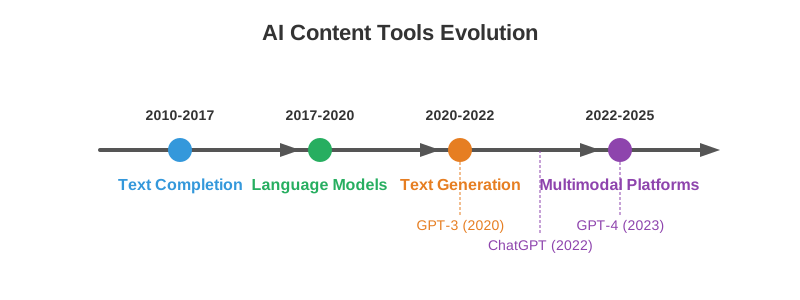
AI content creation has evolved through several distinct generations:
First Generation: Basic Text Completion🔗
-
Simple autocomplete and grammar correction
-
Limited to sentence-level suggestions
-
Primarily focused on fixing errors rather than generating content
Second Generation: Template-Based Generation🔗
-
Fill-in-the-blank content frameworks
-
Basic article generation from outlines
-
Limited creativity and high recognition as "AI-generated"
Third Generation: Contextual Creation🔗
-
Understanding of topic nuances and industry terminology
-
Ability to maintain consistent voice and style
-
Integration of factual information and logical structure
Current Generation: Creative Collaboration🔗
-
AI as thought partner rather than replacement
-
Sophisticated understanding of brand voice and audience expectations
-
Seamless integration across the content creation workflow
The most successful creators today don't use AI to replace human creativity but to amplify it—removing bottlenecks and handling routine aspects while focusing human effort on strategic and creative direction.
For a cutting-edge example of creative collaboration AI, explore Trendly AI's content creation features.
Key Benefits of AI-Enhanced Content Creation🔗
Research by Aberdeen Strategy & Research found that creators using AI-enhanced workflows experience:
-
67% reduction in content production time
-
3.1x increase in publishing frequency
-
48% improvement in engagement metrics
-
57% reduction in content creation costs
These benefits derive from several fundamental advantages:
1. Workflow Acceleration🔗
AI dramatically compresses the time required for:
-
Research compilation: Gathering and synthesizing information from multiple sources
-
Initial drafting: Creating foundational content structures and first drafts
-
Iteration cycles: Testing and refining multiple content approaches
-
Cross-platform adaptation: Transforming content for different platforms and formats
See how Trendly AI's content transformation tools can help you adapt content across platforms in seconds.
2. Ideation Enhancement🔗
Content creators often face the blank page problem—starting from nothing. AI provides:
-
Structured brainstorming: Generating multiple angles and approaches to topics
-
Trend alignment: Connecting your expertise with current conversation topics
-
Content gap identification: Highlighting unexplored areas within your niche
-
Question anticipation: Predicting what your audience wants to know
3. Quality Consistency🔗
Even the most talented creators have variation in their output. AI helps maintain:
-
Style consistency: Ensuring voice and tone remain stable across all content
-
Structural optimization: Following proven content frameworks that perform well
-
Completion insurance: Reducing half-finished projects abandoned due to time constraints
-
Best practice integration: Incorporating content strategies that drive engagement
Ready to experience these benefits firsthand? Try Trendly AI's comprehensive content tools today.
Building Your AI-Enhanced Content Workflow🔗
To maximize the benefits of AI in content creation while preserving your unique value, follow this framework:
Phase 1: Strategic Direction (Human-Led)🔗
The process should always begin with human direction:
-
Audience understanding: Defining who you're creating for and what they need
-
Value proposition: Clarifying the unique perspective or information you provide
-
Content goals: Establishing clear objectives for each piece of content
-
Brand boundaries: Setting guidelines for voice, style, and content approaches
For example, a financial educator might define parameters like:
"Content should explain complex concepts in accessible language without oversimplification, maintain a confident but approachable tone, and always emphasize practical application over theory."
Phase 2: Creative Collaboration (Human-AI Partnership)🔗
With strategic direction established, AI can collaborate on:
-
Content structure: Generating effective outlines and content frameworks
-
Research enhancement: Gathering relevant information and examples
-
Draft development: Creating initial content based on your direction
-
Alternative approaches: Generating multiple versions to evaluate
External Resources🔗
Tagged with

Bhuwan Aryal
Content Marketing Expert
Helping brands track and improve their AI search visibility that resonates with their audience.