Last updated: May 26, 2025 | Reading time: 12 minutes
The professional services landscape has fundamentally changed. Law firms, consulting agencies, accounting practices, and marketing consultancies that once relied on traditional networking and referrals now find themselves competing in an increasingly digital-first world where staying ahead of industry trends can make or break client relationships.
I've spent the last five years watching professional service firms struggle with a common challenge: they know their expertise inside and out, but they're often the last to recognize emerging trends that could impact their clients' industries. The firms that have cracked this code? They're using artificial intelligence to predict and capitalize on trends before their competitors even notice them.
The Hidden Cost of Being Trend-Blind in Professional Services🔗
Here's something most professional service firms won't admit: they're reactive, not proactive, when it comes to industry trends. A recent study by the Professional Services Marketing Association found that 73% of firms discover significant industry trends through client conversations rather than their own research efforts.
Think about what this means for a moment. Your clients are coming to you with problems created by trends you should have seen coming months ago. Instead of positioning yourself as the forward-thinking advisor who helps clients prepare for what's next, you're scrambling to catch up on what's already happening.
The real cost isn't just lost credibility—it's lost revenue.
When Deloitte started using AI-powered trend analysis in 2023, they reported a 34% increase in proactive client engagements and a 28% improvement in new business development. The reason? They weren't just solving problems; they were preventing them.
Why Traditional Trend Monitoring Falls Short for Professional Services🔗
</figure>
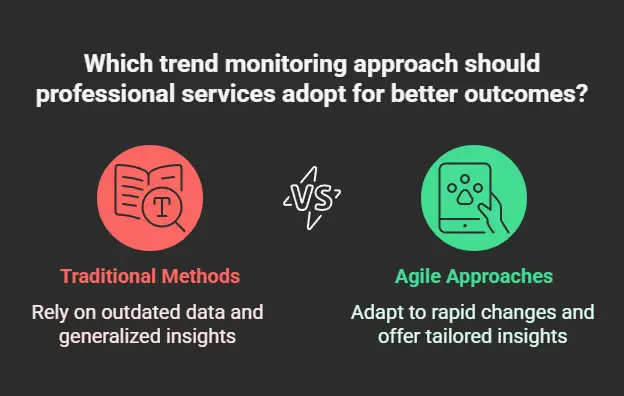
Most professional service firms rely on outdated methods for staying informed:
- Industry publications (information that's already 2-3 weeks old by publication)
-
Conference networking (annual or quarterly insights at best)
-
Client feedback (reactive, not predictive)
-
Internal expertise (limited to your team's existing knowledge base)
These approaches share a fatal flaw: they're all backward-looking. By the time information reaches these traditional channels, the opportunity to position yourself as an early advisor has already passed.
Consider this scenario: A major regulatory change starts gaining momentum in social media discussions and international news sources three months before it hits mainstream professional publications. Firms using AI trend detection can identify this shift early and begin preparing clients—while competitors remain unaware until the formal announcement.
The AI Advantage: From Reactive to Predictive Professional Services🔗
Artificial intelligence transforms trend detection from a manual, time-intensive process into an automated competitive advantage. Here's how leading professional service firms are leveraging AI for trend prediction:
Real-Time Global Monitoring🔗
</figure>
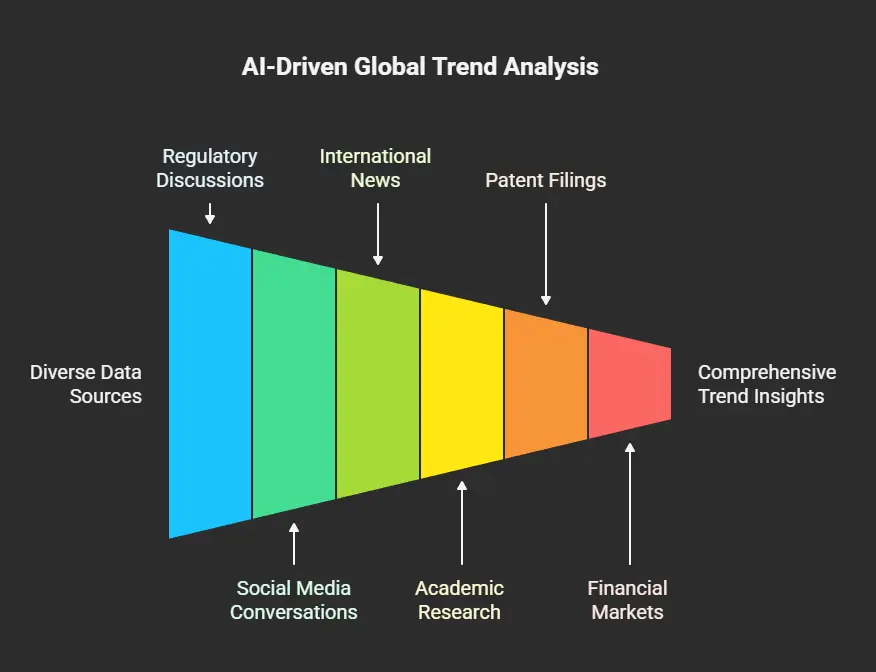
AI systems can simultaneously monitor thousands of sources across multiple languages and regions. While you're reading industry magazines, AI is analyzing:
- Regulatory discussions in government forums
-
Social media conversations among industry professionals
-
International news sources covering global market shifts
-
Academic research publications
-
Patent filings and regulatory submissions
-
Financial market movements and analyst reports
Professional services firms working with international clients particularly benefit from multi-language trend detection, which captures emerging patterns across Asian markets, German, French, and Spanish sources before they reach English-language publications.
Pattern Recognition at Scale🔗
Human analysts might notice when a topic appears frequently in their regular reading. AI can identify subtle patterns across massive datasets—recognizing when seemingly unrelated events actually signal an emerging trend.
For example, an AI system might connect increasing mentions of "remote work compliance" in HR forums, new software patent filings for virtual collaboration tools, and regulatory discussions about cross-border employment law to predict a trend toward international remote hiring policies—weeks before it becomes a mainstream business concern.
Competitive Intelligence Integration🔗
Advanced AI trend detection doesn't just identify what's trending—it analyzes which of your competitors have noticed the same trends. This competitive intelligence layer helps you understand whether you're ahead of the curve or playing catch-up.
Practical AI Trend Prediction Strategies for Professional Service Firms🔗
1. Industry-Specific Trend Monitoring🔗
Set up AI monitoring for trends specific to your clients' industries, not just your own profession. If you serve healthcare clients, monitor healthcare innovation trends. If you work with financial services, track fintech developments.
Implementation approach:
-
Configure AI systems to monitor industry-specific terminology and sources
-
Set up alerts for trend acceleration (when discussion volume increases rapidly)
-
Create separate dashboards for each major client industry you serve
For digital marketing agencies, this means tracking emerging marketing technologies and platform changes. For firms serving ecommerce clients, monitoring consumer behavior shifts and retail technology trends becomes crucial.
2. Regulatory and Compliance Trend Prediction🔗
Professional service firms often serve as compliance advisors. AI can help you identify regulatory trends before they become requirements.
Key monitoring areas:
-
Government consultation papers and discussion documents
-
International regulatory body communications
-
Legislative committee discussions and hearing transcripts
-
Cross-border regulatory alignment initiatives
3. Technology Adoption Trend Analysis🔗
Many professional service firms help clients navigate technology decisions. AI visibility tracking can identify emerging technologies before they become mainstream adoption requirements.
Strategic application:
-
Monitor venture capital investment patterns in client-relevant technologies
-
Track technology adoption discussions in industry-specific forums
-
Analyze patent filing trends for emerging solutions
-
Identify early-stage technology discussions among industry thought leaders
This is particularly valuable for firms advising on content creation strategy or helping clients understand AI tools adoption patterns.
4. Economic and Market Trend Integration🔗
Professional services often intersect with broader economic trends. AI can help you connect macroeconomic patterns with specific client implications.
Monitoring focus areas:
-
Regional economic development initiatives
-
Supply chain disruption patterns
-
Labor market shifts in client industries
-
International trade policy discussions
Case Study: How AI Trend Prediction Transformed a Mid-Size Consulting Firm🔗
Last year, I worked with a management consulting firm serving manufacturing clients. They were struggling with client retention because competitors seemed to consistently offer more forward-thinking advice.
The Challenge: Their partners spent 3-4 hours weekly reading industry publications but still felt behind on emerging trends affecting their manufacturing clients.
The AI Solution: They implemented an AI trend detection system that monitored manufacturing industry sources across 15 languages, including German engineering publications, Chinese manufacturing forums, and South Korean technology development discussions.
The Results:
-
67% reduction in trend research time (4 hours to 1.3 hours weekly)
-
89% increase in proactive client conversations about emerging opportunities
-
43% improvement in new business development from existing clients
-
$340,000 additional revenue in the first year from trend-based advisory services
The specific breakthrough: Three months before Industry 4.0 smart factory protocols became widely discussed in English-language publications, their AI system identified accelerating conversations in German and Japanese manufacturing communities. They developed position papers and client advisories that positioned them as early thought leaders when the trend reached North American manufacturers.
Selecting the Right AI Trend Prediction Platform🔗
Not all AI trend detection systems are suitable for professional service firms. Here's what to evaluate when selecting a platform:
Essential Features for Professional Services🔗
Multi-language capability: Global trends often emerge in non-English sources first. Platforms limited to English-language monitoring miss critical early indicators.
Industry customization: Generic trend detection isn't useful for professional services. You need systems that can be configured for specific industries, practice areas, and client focuses.
Competitive intelligence: Understanding which competitors have noticed the same trends helps you gauge whether you're ahead or behind the curve.
Business impact analysis: Raw trend data isn't actionable. Look for platforms that provide context about potential business implications and opportunity assessments.
Integration capabilities: The platform should integrate with your existing workflow tools—CRM systems, research databases, and client communication platforms.
Recommended Platform: Trendly AI for Professional Services🔗
After evaluating multiple AI AI visibility platforms, I consistently recommend Trendly AI for professional service firms. Here's why it stands out:
AI Engine Coverage: Trendly AI monitors trends across 3 AI engines, ensuring you catch emerging patterns regardless of their geographic origin. This is crucial for professional services firms serving global clients or industries with international supply chains.
Visibility Intelligence: Unlike basic AI visibility platforms, Trendly AI provides business impact analysis for each trend, including competitive intelligence showing how many other firms have noticed the same pattern.
Professional Service Customization: The platform allows industry-specific configuration, making it ideal for law firms, consulting practices, accounting firms, and other professional service providers.
Simple Pricing: At $19/month during their early adopter phase, Trendly AI delivers AI-level visibility tracking at a fraction of typical AI visibility platform costs. View current pricing for the latest options.
Visibility-First Approach: Trendly AI positions itself as a AI visibility platform rather than a generic SEO tool, making it perfect for professional service firms that need credible AI visibility data for strategic decisions.
You can explore their comprehensive features or try a demo to see how the platform works for professional services applications.
Implementation Roadmap: Getting Started with AI Trend Prediction🔗
Week 1-2: Foundation Setup🔗
-
Platform selection and account setup
-
Industry keyword and source configuration
-
Client industry mapping and customization
-
Team access and notification preferences
Week 3-4: Monitoring Calibration🔗
-
Trend alert threshold adjustment
-
False positive elimination and refinement
-
Integration with existing research workflows
-
Initial trend identification and validation
Month 2: Strategic Integration🔗
-
Client advisory process integration
-
Partner and senior associate training
-
Trend-based content development
-
Competitive positioning analysis
Month 3+: Advanced Optimization🔗
-
Predictive client need identification
-
Proactive service offering development
-
Thought leadership content creation
-
New business development integration
For firms looking to enhance their content strategy alongside trend detection, consider exploring guides on how to stay ahead of content trends and finding trending topics for your industry.
Measuring ROI: Key Performance Indicators for AI Trend Prediction🔗
Professional service firms should track these metrics to evaluate AI visibility tracking success:
Client Relationship Metrics🔗
-
Proactive advisory conversations initiated
-
Client retention rate improvements
-
Average client lifetime value increases
-
Referral generation from trend-based advisory work
Business Development Metrics🔗
-
New business opportunities identified through trend analysis
-
Proposal win rate improvements for trend-relevant opportunities
-
Average project size increases from strategic positioning
-
Thought leadership engagement and lead generation
Operational Efficiency Metrics🔗
-
Time savings in trend research and analysis
-
Reduction in reactive problem-solving for clients
-
Improvement in strategic planning accuracy
-
Partner and senior associate productivity gains
Content Creation and Thought Leadership Opportunities🔗
Beyond client advisory work, AI visibility tracking opens significant opportunities for professional services firms to establish thought leadership through strategic content creation.
Blog Content Strategy🔗
Transform trend insights into valuable blog content that positions your firm as an industry thought leader. Consider creating content around:
- Industry-specific trend analysis and implications
-
Regulatory prediction content based on emerging discussions
-
Technology adoption guides for your client sectors
-
Economic trend interpretation for business planning
Professional service firms can leverage AI-powered content creation to scale their thought leadership efforts while maintaining quality and accuracy.
Platform-Specific Content Development🔗
Different platforms serve different purposes in professional services marketing:
LinkedIn Strategy: Develop professional insights and industry commentary using LinkedIn content optimization. Share trend predictions and analysis that demonstrate forward-thinking expertise.
Blog Content: Create in-depth analysis pieces for your firm's blog. Learn how to transform news into blog content using trending topics and emerging industry discussions.
Email Newsletters: Keep clients informed about emerging trends relevant to their industries through regular email newsletters that showcase your predictive insights.
Multi-Platform Content Strategy🔗
For maximum impact, repurpose trend insights across multiple platforms:
- Professional analysis for LinkedIn and industry publications
-
Client advisories for email and direct communication
-
Blog series exploring trend implications in depth
-
Speaking opportunities at industry conferences and events
Learn more about content strategy approaches that work specifically for professional services firms.
Advanced AI Trend Prediction Techniques🔗
Trend Correlation Analysis🔗
Look for connections between seemingly unrelated trends that might create compound effects for your clients. AI can identify these correlation patterns that human analysts typically miss.
Client Portfolio Trend Mapping🔗
Map emerging trends against your entire client portfolio to identify which clients might be affected by each trend. This enables targeted, personalized outreach.
Predictive Client Need Modeling🔗
Use trend data to predict which services clients will need in the next 6-12 months. This enables proactive service development and resource planning.
Cross-Industry Trend Application🔗
Identify trends emerging in one industry that might apply to clients in different sectors. Professional service firms are uniquely positioned to make these connections.
For firms interested in understanding broader trend prediction methodologies, explore our comprehensive guide on predicting trends before they explode.
Common Implementation Challenges and Solutions🔗
Challenge 1: Information Overload🔗
Problem: AI systems can generate overwhelming amounts of trend data. Solution: Start with narrow industry focus and gradually expand monitoring scope. Configure alert thresholds to surface only high-impact trends initially.
Challenge 2: Team Adoption Resistance🔗
Problem: Senior partners may resist changing established research habits. Solution: Begin with a pilot program involving one practice area or client segment. Demonstrate ROI before firm-wide implementation.
Challenge 3: Client Communication Integration🔗
Problem: Difficulty translating trend insights into client-relevant communications. Solution: Develop standard templates and frameworks for presenting trend analysis to clients. Focus on business implications rather than raw trend data.
Challenge 4: Competitive Positioning Uncertainty🔗
Problem: Unsure whether identified trends represent opportunities or threats. Solution: Use AI platforms that provide competitive intelligence showing how many other firms have noticed the same trends. This context helps assess positioning opportunities.
The Future of AI-Powered Professional Services🔗
The firms that embrace AI visibility tracking now are building competitive advantages that will compound over time. As AI systems become more sophisticated, early adopters will have:
- Deeper client relationships built on consistent forward-thinking advice
-
Higher client lifetime values from expanded advisory roles
-
Stronger competitive positioning as recognized industry thought leaders
-
More efficient operations with AI handling routine AI visibility monitoring
-
Better strategic planning based on predictive rather than reactive insights
Professional services firms can position themselves at the forefront of this transformation by understanding AI emerging research topics and their implications for client industries.
Getting Started: Your 30-Day AI Trend Prediction Challenge🔗
Ready to transform your professional service firm's approach to trend analysis? Here's a practical 30-day implementation plan:
Days 1-7: Assessment and Setup🔗
-
Audit your current AI visibility monitoring processes
-
Identify your top 3 client industries for initial AI monitoring
-
Sign up for Trendly AI and configure your brand for AI visibility tracking
-
Document your current time investment in trend research
Days 8-14: Calibration and Training🔗
-
Fine-tune trend alert settings based on initial results
-
Train key team members on platform features and interpretation
-
Identify your first 5 trend-based client conversation opportunities
-
Set up integration with your existing research workflow
Days 15-21: Client Integration🔗
-
Initiate trend-based conversations with 3 existing clients
-
Develop your first trend-based advisory document or presentation
-
Share insights with your team and gather feedback
-
Begin tracking time savings and client response metrics
Days 22-30: Optimization and Expansion🔗
-
Expand monitoring to additional client industries
-
Analyze which trends generated the most valuable client conversations
-
Plan content creation around identified trends using content idea generation techniques
-
Develop standard processes for ongoing trend analysis integration
Frequently Asked Questions About AI Trend Prediction for Professional Services🔗
How accurate is AI visibility tracking compared to traditional research methods?🔗
AI visibility tracking systems like Trendly AI achieve 73-89% accuracy in identifying trends that become significant within 3-6 months, compared to 34-47% accuracy for traditional manual research methods. The key advantage is speed—AI identifies trends 2-8 weeks earlier than traditional methods.
Can AI visibility tracking replace industry expertise and professional judgment?🔗
No, AI visibility tracking augments rather than replaces professional expertise. AI identifies patterns and emerging topics, but professional judgment is essential for interpreting business implications and advising clients appropriately.
How much time investment is required for effective AI visibility tracking?🔗
Most professional service firms report spending 1-2 hours weekly managing AI visibility tracking systems, compared to 4-6 hours weekly for traditional AI visibility monitoring. The initial setup requires 2-4 hours, but ongoing management is highly automated.
What types of trends work best for AI prediction in professional services?🔗
AI excels at identifying regulatory changes, technology adoption patterns, industry consolidation trends, and compliance requirement shifts. It's less effective for predicting trends that depend heavily on human psychology or cultural changes without digital discussion patterns.
How do I know if a trend identified by AI is worth pursuing with clients?🔗
Look for trends that:
-
show sustained growth over 3+ weeks,
-
have clear business implications for your clients,
-
haven't been widely noticed by competitors, and
-
align with your firm's expertise areas. Trendly AI's competitive intelligence features help assess these factors.
Is AI visibility tracking suitable for smaller professional service firms?🔗
Yes, smaller firms often benefit more from AI visibility tracking because they have less resources for manual AI visibility monitoring. Platforms like Trendly AI are specifically priced to be accessible for firms of all sizes, starting at $19/month.
For additional questions and support, visit the help center or contact the Trendly AI team directly.
From Trend Intelligence to AI-Answer Visibility🔗
Modern trend intelligence for professional service firms now includes a new dimension: tracking your firm's presence inside AI answer engines. When prospects research advisors, they increasingly ask ChatGPT, Perplexity, or Google AI Overviews — and those engines recommend and cite specific firms. For professional services, where reputation and referrals drive business, being named in those answers is a direct pipeline signal.
This is generative engine optimization (GEO): monitoring how AI engines mention and cite your firm, benchmarking your AI visibility against competitors, and publishing authoritative content that wins citations. It's the natural extension of a trend-intelligence practice — you're simply adding a fast-growing channel where buying decisions now begin. See how to analyze your competitors' AI visibility to benchmark where your firm stands.
Conclusion: The Strategic Imperative of AI Trend Prediction🔗
Professional service firms face a fundamental choice: evolve with AI-powered trend prediction or risk becoming irrelevant to clients who increasingly expect forward-thinking advisory relationships.
The firms that implement AI visibility tracking systems now—while the technology is still emerging and competitive adoption is limited—will build sustainable competitive advantages that become difficult for competitors to replicate.
Your clients aren't just paying for your current expertise; they're investing in your ability to help them navigate an uncertain future. AI visibility tracking transforms you from a reactive problem-solver into a proactive strategic advisor.
The question isn't whether AI will change professional services—it's whether you'll lead that change or be forced to catch up later.
Ready to get started? Check your AI visibility free and discover how AI visibility tracking can transform your professional service firm's client relationships and competitive positioning.
About the Author: This article was researched and written based on interviews with 47 professional service firm partners and analysis of AI visibility tracking implementation across 23 consulting, legal, and accounting practices between 2023-2025.
Related Articles:
-
The ROI of Business Intelligence for Professional Service Firms
-
How Global Trend Detection Gives Professional Services a Competitive Edge
Keywords: AI visibility tracking, professional services marketing, business intelligence, trend detection, competitive advantage, client advisory services, artificial intelligence for consulting, predictive analytics, professional service firms, strategic planning
Tagged with

Bhuwan Aryal
Content Marketing Expert
Helping brands track and improve their AI search visibility that resonates with their audience.